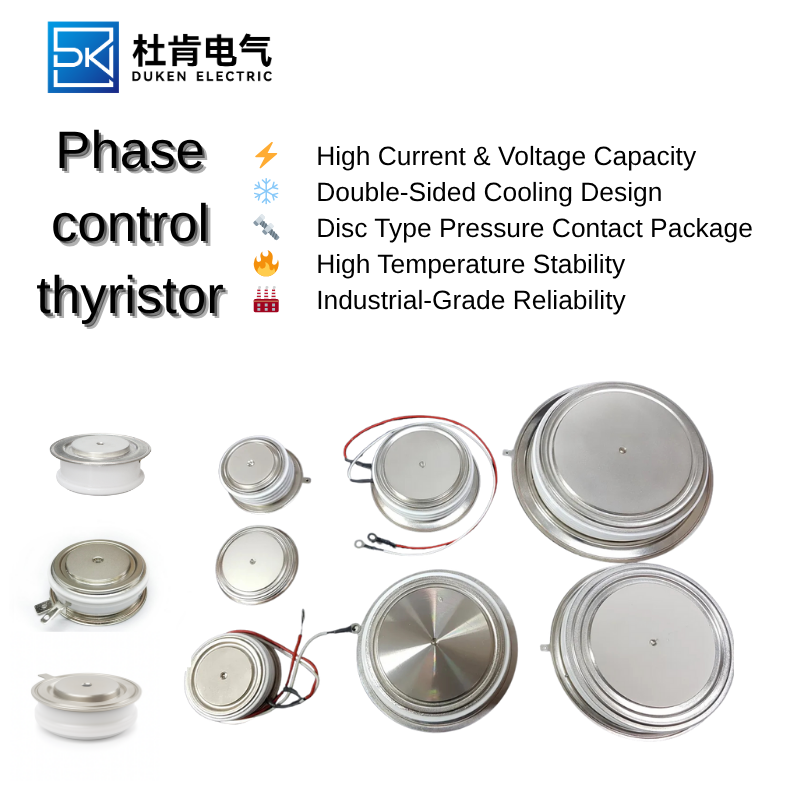
4000A Phase Control Thyristor Installation Guide for High-Power Industrial Systems
Installing a high-current thyristor correctly is not only a mechanical task but also a system-level reliability decision. In heavy industrial environments, a 4000A device is usually part of a larger power conversion chain that supports process stability, thermal safety, and long equipment life. A well-planned installation guide should therefore cover mounting preparation, heat dissipation, electrical connection, insulation coordination, and final commissioning. This is especially important when the device will operate in demanding applications such as mining, metallurgy, and industrial heating.
Understanding the installation context
A 4000A phase control thyristor is commonly selected for applications where very large currents must be controlled with predictable conduction behavior. Before starting installation, engineers should verify the cabinet layout, cooling path, busbar alignment, and protection coordination. In many retrofit projects, the device is expected to replace older SCR assemblies while improving thermal performance and serviceability.
When a system is designed for mining equipment power control forced-cooling heat sink 4000A phase control thyristor, the installation approach should account for vibration, dust, and long duty cycles. That means the mounting base must be flat, the cooling assembly must be rigid, and all electrical joints must resist thermal cycling. A poor mechanical interface can create local hotspots that shorten device life even when the electrical rating appears sufficient.
Pre-installation checks
Mechanical inspection
Before the thyristor is mounted, inspect the contact surfaces carefully. The pressure faces of the device and the mating heat sink plates should be clean, smooth, and free from burrs or oxidation. Any unevenness may create non-uniform clamping force. In large assemblies, the mounting frame should also be checked for torsion, because misalignment can stress the ceramic housing.
Thermal interface planning
The thermal interface is often underestimated. For a 4000A assembly, even a small increase in contact resistance can produce a substantial rise in junction temperature. Engineers should use approved thermal compound in the correct amount and follow the manufacturer’s specified clamping procedure. In systems using AC power regulators datasheet KP4000A-6500V 4000A phase control thyristor, the thermal path is typically defined together with pressure force and cooling-air requirements, so installation should never ignore datasheet recommendations.
Electrical compatibility
At this stage, confirm that the nominal line voltage, surge conditions, gate trigger design, and protective network all match the selected device. Cable routing should already be planned to separate gate wiring from noisy power conductors. For cabinets serving large-scale heating elements 6500 V VRRM 4000A phase control thyristor, attention should be given to insulation distances and transient suppression because repeated heating cycles can produce strong electrical and thermal stress.
Mounting procedure
Step 1: Prepare the base and heat sink
Clean the clamping surfaces with a lint-free cloth and approved solvent. Apply thermal compound in a thin, even film rather than a thick layer. The objective is to fill microscopic voids, not to create a soft barrier. In a mining equipment power control forced-cooling heat sink 4000A phase control thyristor arrangement, the cooling channels and airflow direction should also be checked before the device is seated, since later correction may require disassembly.
Step 2: Position the thyristor correctly
Place the thyristor carefully between the pressure plates or designated mounting interfaces. Observe polarity and terminal orientation exactly as shown in the project drawing. The gate and cathode auxiliary leads should be positioned to avoid unnecessary bending stress. If multiple devices are installed in the same cubicle, leave adequate service access for inspection and replacement.
Step 3: Apply clamping force in sequence
Uniform clamping force is critical. Tighten the assembly gradually in stages and follow a cross-pattern sequence when required. Never exceed the specified pressure range. Excessive force may damage the package, while insufficient force increases thermal resistance. This step is particularly important in designs based on AC power regulators datasheet KP4000A-6500V 4000A phase control thyristor, because the published performance assumes correct mounting pressure.
Electrical connection and protection
Busbars should be aligned so the installed device is not pulled sideways by conductor stress. Flexible connectors are often preferred in high-current systems because they absorb expansion and vibration. Every connection surface should be cleaned and torqued to specification. Engineers should also install RC snubbers, semiconductor fuses, surge suppression, and gate-trigger components according to the circuit design.
In applications for large-scale heating elements 6500 V VRRM 4000A phase control thyristor, symmetrical busbar layout helps reduce stray inductance and supports more stable switching behavior. Gate leads should be short, twisted if appropriate, and isolated from high-current paths to reduce false triggering.
Cooling verification and commissioning
Before energizing, verify fan rotation, airflow volume, and air path obstruction. A forced-air system should not only move enough air but distribute it evenly across the heat sink surfaces. For a mining equipment power control forced-cooling heat sink 4000A phase control thyristor, filter maintenance and dust control should be part of the installation checklist from day one. Restricted airflow can make even a correctly mounted device fail early.
Next, perform insulation resistance checks, continuity tests, and gate trigger verification at low energy. During first power-up, increase load gradually while monitoring heat sink temperature, voltage drop, and trigger stability. Systems using AC power regulators datasheet KP4000A-6500V 4000A phase control thyristor should be compared against expected operating curves to confirm that the installed assembly behaves within design limits.
Finally, observe thermal equilibrium under real load. In cabinets feeding large-scale heating elements 6500 V VRRM 4000A phase control thyristor circuits, commissioning should include several load transitions to confirm stable operation during ramp-up and sustained heating. Good installation is not proven by a successful startup alone; it is proven by repeatable, safe behavior under production conditions.
A proper 4000A phase control thyristor installation guide must combine mechanical precision, electrical discipline, and thermal awareness. When these three areas are treated as one integrated process, the result is safer operation, better controllability, and longer service life. In high-power industrial systems, careful installation is the foundation of dependable performance.