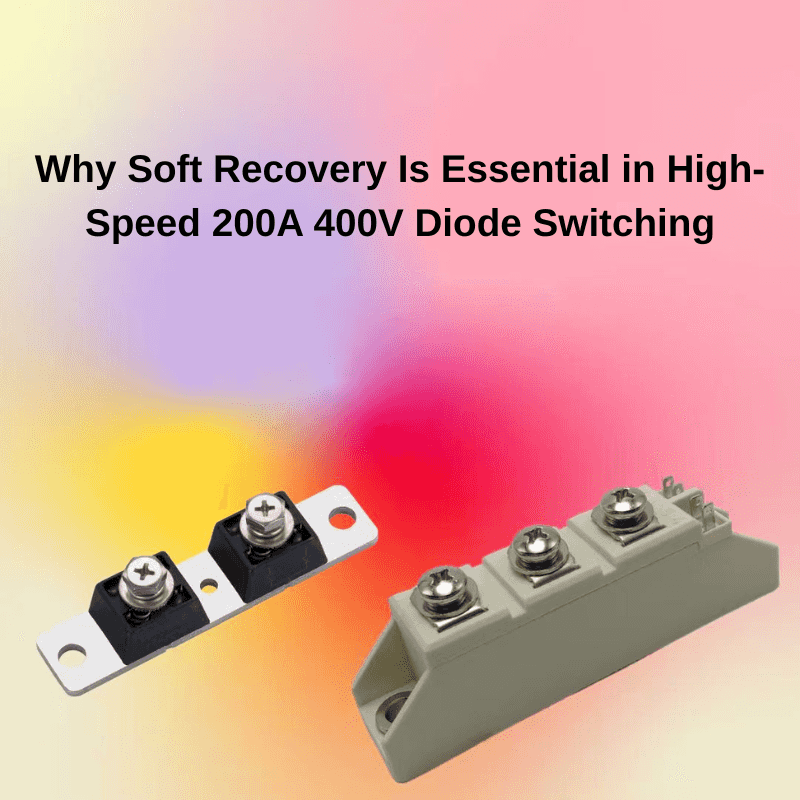
Why Soft Recovery Is Essential in High-Speed 200A 400V Diode Switching
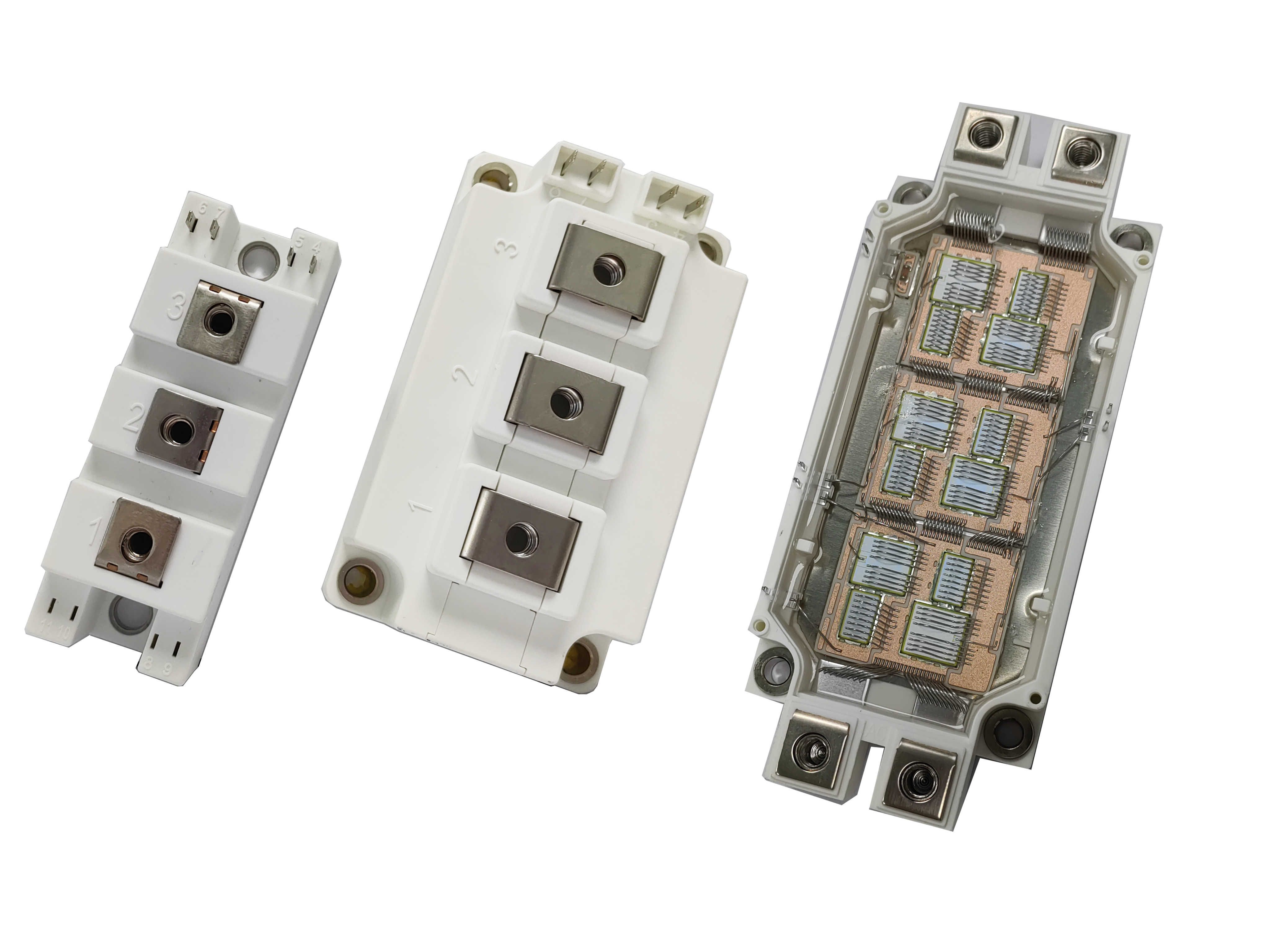
Modern power conversion applications demand fast, clean, and efficient switching — a domain where soft recovery diodes excel. For systems designed around 200A 400V fast recovery diodes, soft recovery behavior can make a significant difference in minimizing electrical noise, improving thermal performance, and maintaining system integrity. This article examines its critical role in systems including for solar inverter stud mount DO-9 used in welding machine, automotive SOT-227 high-temp platforms, and bridge rectifier modules for motor drives.
1. Soft Recovery: The Missing Piece in High-Speed Switching
Soft recovery describes how gradually a diode stops conducting during reverse recovery. This transition is crucial because an abrupt switch-off, common in hard-recovery diodes, generates high-frequency noise, voltage spikes, and ringing. These transients can propagate through the power path and disrupt nearby control electronics.
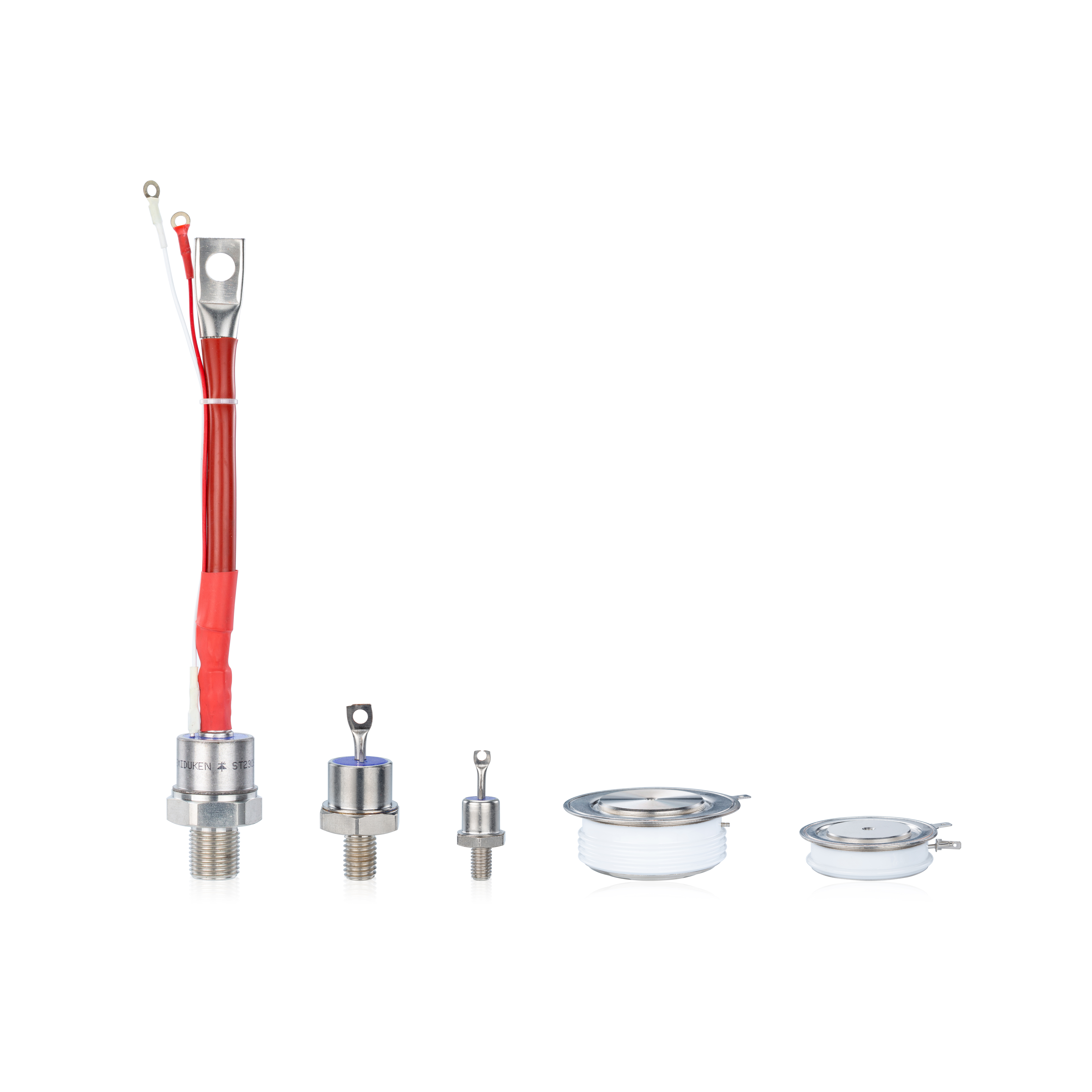
In systems using the for solar inverter stud mount DO-9 used in welding machine 200A 400V fast recovery diode, these spikes can destabilize controller logic and power factor correction stages. By reducing di/dt and associated overshoot, soft recovery helps maintain waveform integrity and lowers electromagnetic interference (EMI), enhancing overall system stability.
2. Enhanced Efficiency at High Temperatures
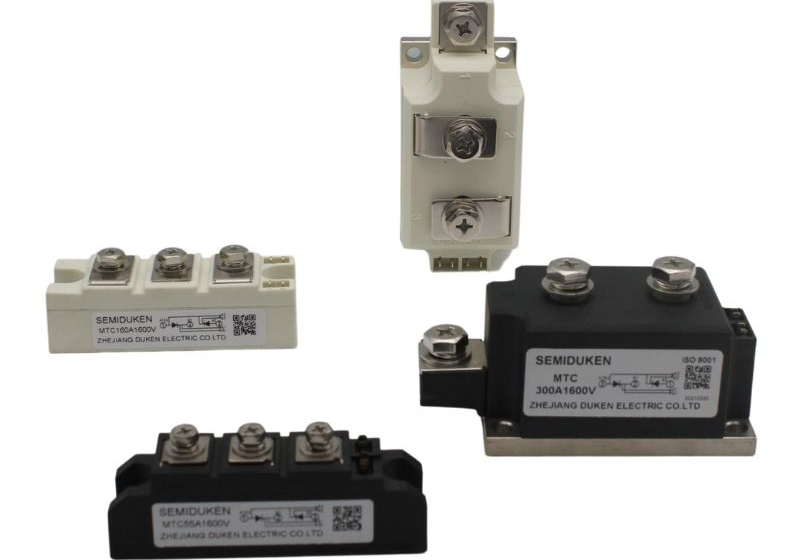
The SOT-227 package automotive application high temperature 150°C 200A 400V fast recovery diode is engineered for rugged automotive environments, where thermal management is a constant concern. Under extreme temperatures, diodes with poor recovery characteristics can suffer from increased reverse recovery time and associated losses.
Soft recovery mitigates this by offering smoother transitions, leading to lower junction heating and more predictable energy dissipation. In electric vehicles, this ensures consistent performance of onboard chargers, DC/DC converters, and powertrain inverters, even during temperature spikes. This capability is essential in meeting the high thermal reliability standards demanded in automotive-grade applications.
3. Quiet and Reliable Operation in Motor Drives
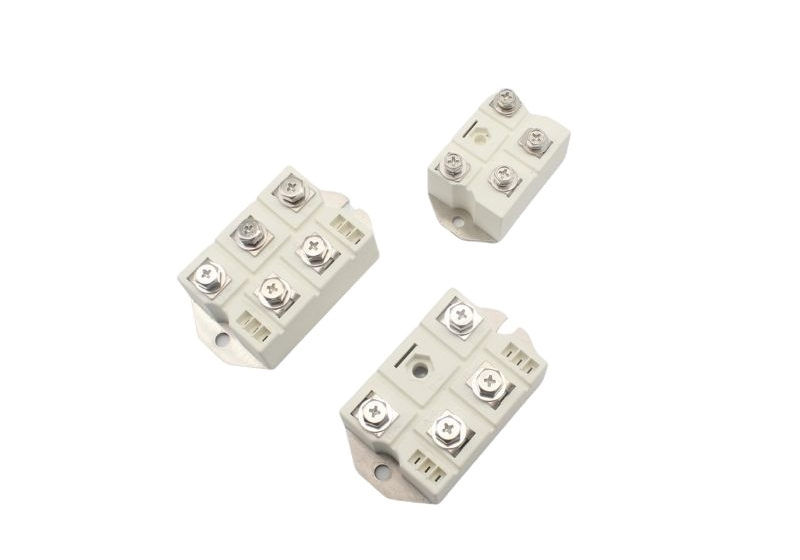
In motor drive applications, switching frequency and control precision go hand in hand. A fast reverse recovery for bridge rectifier module for motor drive application 200A 400V fast recovery diode must handle frequent current reversals without inducing torque ripple or electromagnetic noise.
Soft recovery diodes in this context significantly reduce the stress on gate drivers and IGBT modules by limiting voltage ringing and suppressing noise. They help prevent system instability caused by transient feedback into sensitive control loops. The result is smoother motor operation, higher efficiency, and reduced acoustic noise — especially important in consumer-facing motor applications like elevators or HVAC systems.
4. Superior Control in Renewable and Industrial Power Systems
Soft recovery finds a natural home in renewable and industrial applications that require clean energy conversion under high switching speeds. In for solar inverter stud mount DO-9 used in welding machine designs, recovery smoothness enhances inverter output accuracy and reduces harmonics, which in turn minimizes the burden on output filters.
For welding systems, where load fluctuations are common and power output must be precisely controlled, soft recovery diodes provide better arc stability. This contributes to cleaner welds, fewer defects, and longer equipment lifespan. Additionally, thermal cycling in such industrial environments makes soft switching an invaluable feature for maintaining performance over time.
5. System-Level Advantages: Reduced EMI, Improved Durability
Choosing a SOT-227 package automotive application high temperature 150°C 200A 400V fast recovery diode or a fast reverse recovery bridge rectifier diode with soft recovery doesn’t just improve individual component behavior — it enhances the entire system's electromagnetic and thermal profile. Designers benefit from reduced need for external snubber circuits, simplified layout constraints, and greater design flexibility in high-density environments.
Similarly, in solar or welding setups utilizing the for solar inverter stud mount DO-9 used in welding machine 200A 400V fast recovery diode, soft recovery ensures the power path remains stable and thermally managed. This translates to less heat generation, lower passive cooling requirements, and longer intervals between maintenance cycles.
6. Conclusion: A Design Investment Worth Making
Engineers often focus on forward voltage drop, surge current capability, and packaging, but overlooking recovery behavior can compromise a design's overall effectiveness. Whether implementing SOT-227 automotive diodes, integrating bridge rectifier modules for motor drives, or deploying DO-9 diodes in solar inverter and welding machines, soft recovery behavior is essential for high-performance, high-reliability designs.
By choosing 200A 400V fast recovery diodes with soft switching characteristics, system designers can achieve reduced EMI, enhanced thermal management, and longer device lifespans — all of which contribute to better-performing and more reliable electronics.