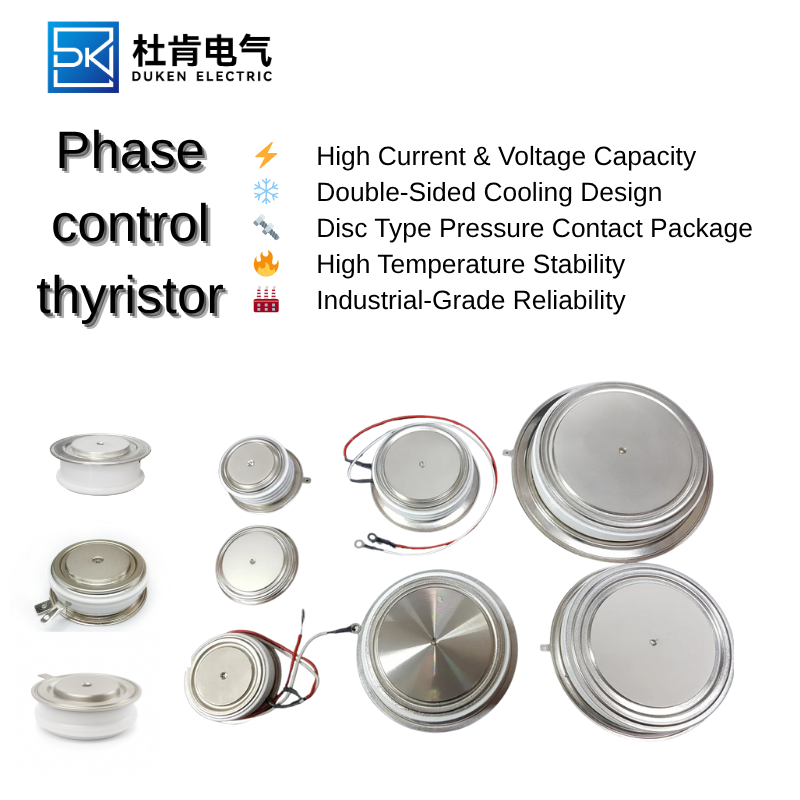
Commissioning an 800A Phase Control Thyristor for Stable Industrial Operation
Commissioning an 800A phase control thyristor is the final and most important stage after mechanical installation, wiring, and cooling preparation. Even when the device has been correctly selected, poor commissioning can lead to unstable firing, excessive heat, current imbalance, or early failure. A structured commissioning process helps engineers confirm that the thyristor, heat sink, gate driver, protection circuit, and load all work together safely.
Before power is applied, review the AC power regulators datasheet KP800A-6500V 800A phase control thyristor specifications again. The datasheet should be compared with the actual cabinet design, including operating voltage, rated current, gate trigger values, surge protection, and thermal capacity. This step prevents the common mistake of assuming that a correctly purchased thyristor is automatically suitable for every working condition.
Start with a visual and mechanical inspection. Check that the thyristor is installed in the correct polarity, the clamp is evenly tightened, and the heat sink surfaces are properly aligned. In a mining equipment power control forced-cooling heat sink 800A phase control thyristor installation, vibration-resistant fasteners and firm busbar supports are especially important. Mining environments often expose cabinets to dust, shock, and unstable power quality, so loose connections must be eliminated before energizing.
Cooling verification should be completed before load testing. Fans must rotate in the correct direction, filters must be clean, and airflow should pass through the entire heat sink. A mining equipment power control forced-cooling heat sink 800A phase control thyristor system should also include temperature monitoring near the heat sink base. Measuring only cabinet air temperature is not enough because the thyristor junction may be much hotter than the surrounding air.
Next, inspect the gate drive circuit. Gate and auxiliary cathode leads should be routed away from main power conductors. The firing board must provide a reliable pulse over the full operating range. Compare the trigger requirements with the AC power regulators datasheet KP800A-6500V 800A phase control thyristor data to ensure proper compatibility. Weak or noisy trigger signals can cause delayed conduction, phase imbalance, and unwanted heat generation.
Protection components should also be checked. RC snubbers, surge absorbers, and semiconductor fuses must be correctly connected and rated. For a large-scale heating elements 6500 V VRRM 800A phase control thyristor controller, protection is critical because heater banks can produce long-duration current stress. If a fault occurs, fast protection reduces the risk of device rupture and secondary cabinet damage.
During the first power test, use a controlled load whenever possible. Begin at a low conduction angle and increase output gradually. Monitor input voltage, load current, heat sink temperature, and waveform symmetry. A properly commissioned thyristor should respond smoothly as the firing angle changes. In large-scale heating elements 6500 V VRRM 800A phase control thyristor applications, current should rise steadily without sudden jumps or uneven phase loading.
Thermal observation should continue beyond the first few minutes. High-current devices may appear stable at the beginning but slowly rise in temperature as the heat sink reaches equilibrium. Record the temperature at several load levels. For a mining equipment power control forced-cooling heat sink 800A phase control thyristor cabinet, this temperature record becomes a useful reference for future maintenance and troubleshooting.
After the system reaches normal operation, check for abnormal sound, odor, vibration, and waveform distortion. Inspect the cabinet for hot spots using appropriate instruments. Busbar joints, fuse holders, and cable terminals should be observed because resistance heating may occur outside the thyristor itself. In a large-scale heating elements 6500 V VRRM 800A phase control thyristor system, terminals connected to heater banks should be checked carefully due to continuous current flow.
Final documentation is part of proper commissioning. Record the device model, installation date, clamping method, heat sink type, fan specification, gate driver settings, protection components, load current, and operating temperature. Keep the AC power regulators datasheet KP800A-6500V 800A phase control thyristor reference with the equipment file so future maintenance teams can verify limits quickly.
A successful commissioning process confirms that the thyristor is not only installed correctly but also operating safely under real load conditions. By checking mechanical pressure, forced cooling, gate drive quality, protection coordination, and temperature rise, engineers can reduce downtime and extend service life. In heavy industries, careful commissioning turns a high-current semiconductor into a dependable power-control component.