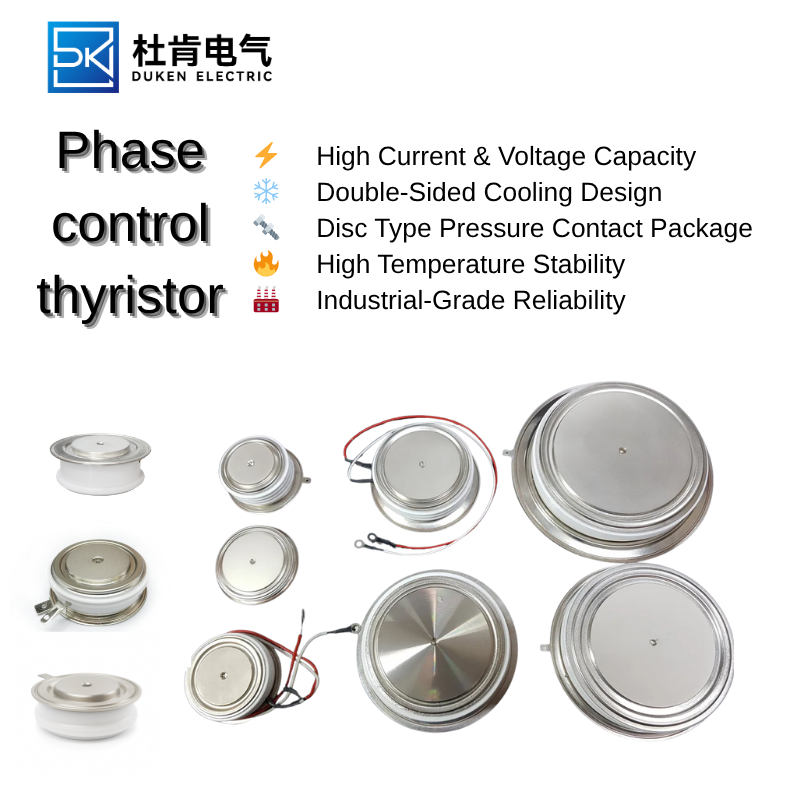
Selecting the Right 3000A Phase Control Thyristor for High-Power Rectifier Design
Choosing a high-current semiconductor for a rectifier is never a matter of selecting the largest current rating and moving on. In industrial power engineering, the right component must align with electrical stress, thermal design, application behavior, and service expectations. A 3000A phase control thyristor for DC rectifier systems is widely used when engineers need strong current handling, controlled switching, and repeatable performance under load variation. In demanding sectors, phrases like mining equipment power control 6500 V VRRM 3000A phase control thyristor reflect the need for strong reverse blocking ability and dependable behavior in rugged field conditions. Meanwhile, requirements associated with electromagnetic heating systems high dv/dt immunity 3000A phase control thyristor highlight the importance of transient tolerance in electrically noisy environments. Where controlled acceleration is essential, a soft-start motor drive low on-state voltage drop 3000A phase control thyristor supports efficient current flow and improved thermal balance.
Understanding the Main Electrical Parameters
When evaluating a 3000A phase control thyristor, engineers should begin with the core electrical ratings. Average current rating is important, but it must be viewed in relation to cooling conditions, duty cycle, and waveform shape. A device that performs well in one rectifier topology may require substantial derating in another.
VRRM is one of the most important parameters in high-power rectifier design. A higher repetitive reverse voltage rating improves tolerance against overvoltage events and line disturbances. In large transformers, long cable runs, and inductive switching networks, transient spikes are common. This is why mining equipment power control 6500 V VRRM 3000A phase control thyristor specifications are especially relevant where electrical conditions are harsh and operating continuity matters.
Engineers should also study surge current capability. Industrial DC systems can experience startup events, temporary short-duration overloads, or irregular process demands. A device with sufficient non-repetitive surge handling will better survive fault conditions or abnormal line events. Gate sensitivity and trigger consistency are equally important, since inaccurate firing can reduce control precision and increase heat generation in the bridge.
Matching the Device to the Operating Environment
A high-power thyristor does not work in isolation. It operates within a system shaped by ambient temperature, cooling airflow, mechanical mounting quality, and the behavior of adjacent components. Proper device selection therefore requires a full environmental view.
For example, thermal processing equipment often generates strong electromagnetic interference and fast switching transients. Under those conditions, electromagnetic heating systems high dv/dt immunity 3000A phase control thyristor performance becomes vital. Good dv/dt immunity helps prevent unintended triggering and ensures that conduction begins only when commanded by the control circuit. This protects both output quality and system stability.
Mechanical environment matters as well. Mining, transport-linked equipment, and outdoor converter stations may face dust, shock, and uneven maintenance access. In these cases, the value behind mining equipment power control 6500 V VRRM 3000A phase control thyristor selection extends beyond a datasheet number. It reflects the need for stronger design margin when the cost of failure is high and replacement may not be immediate.
The Role of Conduction Loss and Thermal Efficiency
The thermal behavior of a rectifier often determines its real-life reliability. Every watt lost in conduction must be removed through heatsinks or cooling systems. In a 3000A device, even modest differences in on-state voltage drop can become meaningful over long duty cycles.
That is why engineers frequently prioritize soft-start motor drive low on-state voltage drop 3000A phase control thyristor characteristics in current-intensive applications. A lower on-state voltage drop means lower conduction losses, reduced junction temperature, and less stress on the cooling assembly. This can improve efficiency while also extending component life.
The benefit is especially clear in soft-start motor drive systems. During controlled acceleration, the thyristor must carry significant current while managing firing angle and heat rise. Lower voltage drop reduces cumulative thermal strain across repeated starts. In many industrial plants, this improvement translates into fewer thermal alarms, more stable operating margins, and a lower risk of premature aging.
The same principle applies to continuously loaded rectifiers. Lower conduction losses reduce the burden on fans, liquid cooling loops, and thermal interfaces. Over time, that contributes to better system-level efficiency and more predictable maintenance intervals.
Building a Better Selection Strategy
The best selection process combines application analysis with realistic operating assumptions. Engineers should define actual current waveform, overload profile, ambient range, cooling method, and expected service life before finalizing a device. It is also wise to verify clamping force requirements, isolation strategy, and compatibility with snubber and firing circuits.
Where interference is strong, electromagnetic heating systems high dv/dt immunity 3000A phase control thyristor capability should carry more weight in the decision. Where thermal economy is central, soft-start motor drive low on-state voltage drop 3000A phase control thyristor performance becomes a key advantage. And where high blocking margin is required, mining equipment power control 6500 V VRRM 3000A phase control thyristor criteria provide an effective benchmark for dependable high-stress operation.
A well-chosen 3000A phase control thyristor supports more than electrical conversion. It improves controllability, protects uptime, and reduces system stress across the entire rectifier platform. In high-power DC design, careful selection at the component stage often prevents the most expensive problems later in the lifecycle.