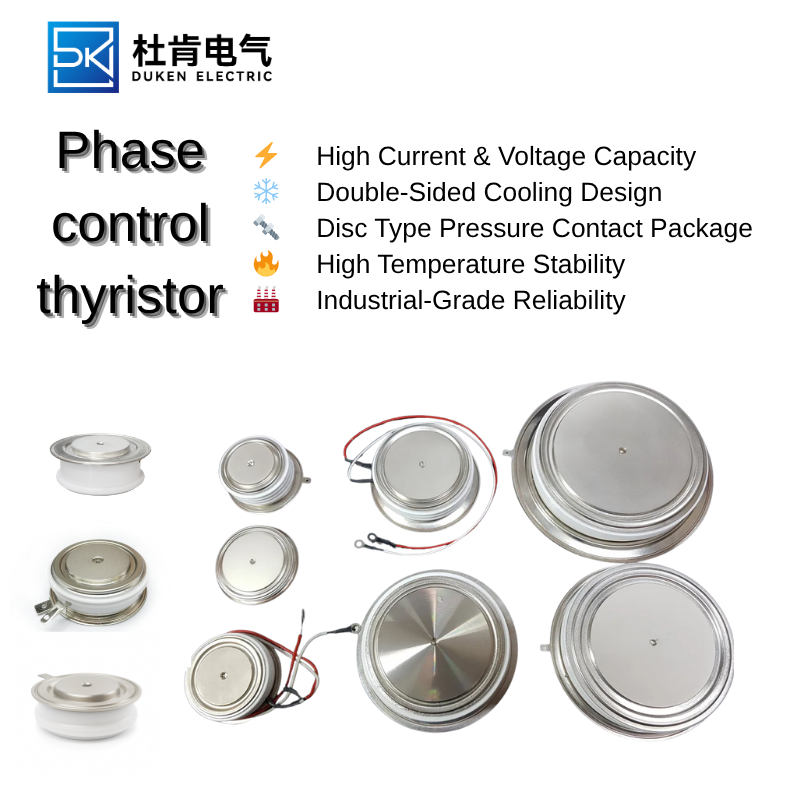
Low On-State Voltage Drop Advantages in 3000A Phase Control Thyristor Solutions
In high-current rectifier systems, efficiency is often discussed in terms of transformers, cooling systems, and control strategy, but semiconductor conduction loss is just as important. The electrical behavior of the switching device directly influences heat generation, reliability, and operating cost. A 3000A phase control thyristor for DC rectifier service is commonly used where heavy current and controlled conversion must be maintained over long periods. In installations facing severe voltage stress, mining equipment power control 6500 V VRRM 3000A phase control thyristor requirements bring attention to blocking margin and rugged operation. In electrically noisy thermal processes, electromagnetic heating systems high dv/dt immunity 3000A phase control thyristor performance helps maintain controlled switching. For current ramping applications, the benefits of a soft-start motor drive low on-state voltage drop 3000A phase control thyristor can be especially valuable because lower conduction loss improves both thermal and system efficiency.
What Low On-State Voltage Drop Really Means
On-state voltage drop is the voltage present across the thyristor while it is conducting current. Although the value may seem modest, the power loss created by that voltage can be substantial at 3000A. Even a small reduction in drop can translate into a meaningful reduction in heat across long operation periods.
This matters because every additional watt must be removed from the semiconductor junction and the heatsink assembly. Higher heat raises device temperature, stresses insulation materials, and increases cooling demand. That is why soft-start motor drive low on-state voltage drop 3000A phase control thyristor performance is often seen as a direct contributor to lifecycle reliability rather than just electrical efficiency.
In large rectifier systems, the thermal effect multiplies across multiple devices in a bridge. Lower loss in each thyristor can reduce the total heat load of the converter cabinet, improve temperature uniformity, and lessen dependence on aggressive cooling strategies.
Why It Matters in Motor Start and Process Control
Soft-start motor systems rely on controlled current increase to reduce mechanical shock and electrical stress during startup. The thyristor must carry high current while gradually adjusting conduction angle. Under these conditions, conduction loss becomes a practical concern because repeated starts create repeated thermal pulses.
This is where soft-start motor drive low on-state voltage drop 3000A phase control thyristor selection provides measurable value. Lower voltage drop reduces heat buildup during each start event and helps the assembly return to a safer thermal baseline more quickly. Over time, that can improve repeatability and extend maintenance intervals.
The same idea applies to continuous process power supplies. In many heavy-duty plants, the rectifier runs for long shifts or even around the clock. Lower semiconductor loss supports better energy efficiency and more stable device temperature. When paired with adequate cooling, this improves the operating margin of the whole converter.
At the same time, thermal efficiency should not distract from electrical ruggedness. Systems in remote extraction and bulk handling facilities still need the reverse voltage strength associated with mining equipment power control 6500 V VRRM 3000A phase control thyristor performance. Efficient conduction is most valuable when it is combined with high-stress survivability.
The Balance Between Efficiency and Robustness
No single parameter determines the quality of a thyristor. A low on-state voltage drop is highly desirable, but engineers must still evaluate surge current rating, dv/dt tolerance, gate behavior, and thermal resistance. A device that is efficient but vulnerable to switching transients may not deliver dependable field performance.
For heating and induction systems, electromagnetic heating systems high dv/dt immunity 3000A phase control thyristor capability remains essential. Fast voltage changes can produce false triggering or unstable switching if the device and circuit are not designed with adequate immunity. Therefore, the most practical choice is often a thyristor that balances low conduction loss with high transient tolerance.
Mechanical mounting quality also affects results. Poor clamping force or uneven thermal contact can erase the benefit of a lower voltage drop by increasing localized heating. To fully realize the value of a low-loss device, engineers should treat the thermal path as part of the semiconductor selection process.
A Smarter Way to Evaluate Value
Procurement decisions sometimes focus too heavily on initial price, but the more meaningful comparison is total operating value. A thyristor that runs cooler, wastes less energy, and supports longer service intervals may reduce costs over the life of the equipment even if its purchase price is higher.
That is why soft-start motor drive low on-state voltage drop 3000A phase control thyristor specifications are increasingly relevant in industrial upgrading projects. Plants want better efficiency, lower heat stress, and more predictable reliability without redesigning the entire power platform. At the same time, high-voltage durability remains essential, making mining equipment power control 6500 V VRRM 3000A phase control thyristor solutions attractive where safety margin cannot be compromised. In environments with strong switching interference, electromagnetic heating systems high dv/dt immunity 3000A phase control thyristor performance completes the picture.
A low on-state voltage drop does more than reduce losses. In 3000A phase control thyristor solutions, it supports cooler operation, stronger reliability, and better long-term value for demanding DC rectifier applications.