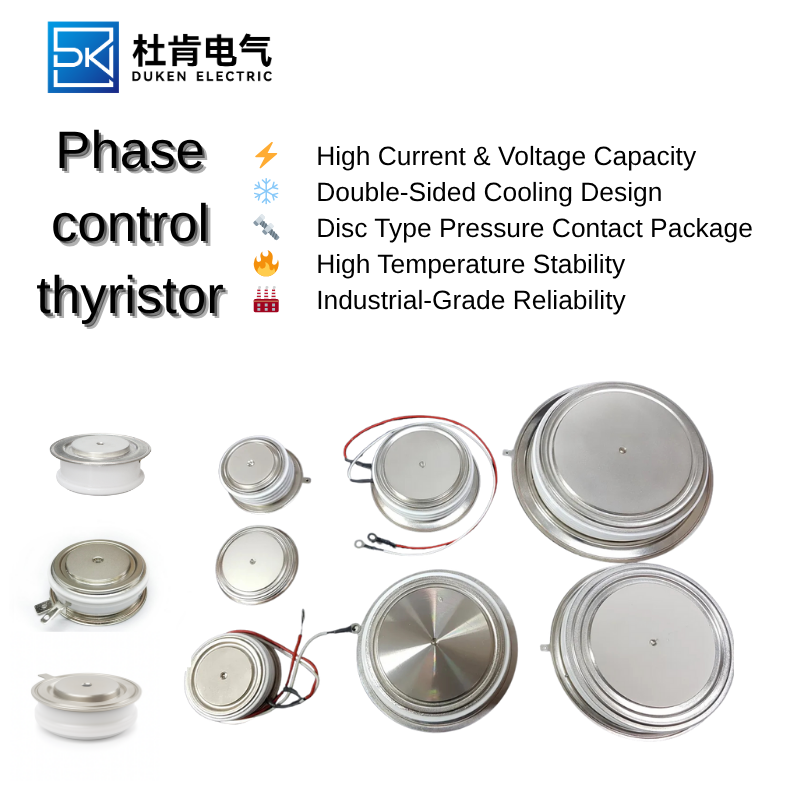
Electrical Connection and Protection Design for a 4000A Phase Control Thyristor
A 4000A phase control thyristor is only as reliable as the electrical system built around it. While the semiconductor itself may be rated for very high current and voltage, safe operation depends on correct busbar design, gate triggering, insulation coordination, surge protection, and fault management. In large industrial converters, installation errors in the electrical layout can introduce overheating, nuisance triggering, uneven current flow, or catastrophic failure during transients.
Building the right electrical foundation
The first principle of connection design is that current should flow through the thyristor assembly with minimal stray inductance, low joint resistance, and predictable mechanical stress. In high-current cabinets, conductor geometry matters almost as much as conductor size. Poor alignment, sharp routing changes, and unsupported busbar weight can create both thermal and mechanical problems.
In applications involving mining equipment power control forced-cooling heat sink 4000A phase control thyristor, the electrical design should also account for shock, vibration, and contamination. Mechanical robustness is therefore part of electrical reliability. Busbars must be firmly supported, but not in a way that transfers expansion stress into the semiconductor body.
Busbar design and current path control
Low resistance joints
All bolted joints should be cleaned, finished properly, and torqued according to specification. Uneven joint pressure creates additional resistance, and in a 4000A system even a small resistance increase can lead to serious heating. Busbar surfaces should be matched carefully, and installers should avoid forced assembly where conductors do not line up naturally.
Stray inductance reduction
The current path should be compact and symmetrical. Long loops increase stray inductance, which can produce voltage overshoot during switching events. This is especially important in systems referenced to AC power regulators datasheet KP4000A-6500V 4000A phase control thyristor, because the actual switching stress seen by the installed device may exceed steady-state expectations if the physical layout is poor.
Gate trigger and control wiring
Gate wiring deserves special attention because a high-power thyristor can only perform well when it receives a clean, properly timed trigger signal. Trigger circuits should provide adequate pulse amplitude and duration while remaining isolated from power-stage noise. Gate leads should be routed away from high-current conductors, and unnecessary loop area should be avoided.
For systems serving large-scale heating elements 6500 V VRRM 4000A phase control thyristor loads, trigger stability is particularly important during partial-load control, where conduction angle accuracy affects process temperature and power quality. Electrical noise, improper grounding, or long control wiring can degrade performance in subtle but costly ways.
Protective networks and fault containment
RC snubbers and surge suppression
A phase control thyristor must be protected from excessive dv/dt and transient overvoltage. RC snubbers are commonly used to moderate voltage rise, while metal oxide varistors or other surge devices may be included depending on the system design. The protective network should be placed with careful regard for lead length and actual circuit geometry.
In mining equipment power control forced-cooling heat sink 4000A phase control thyristor service, protection design should assume a harsh electrical environment with frequent disturbances from large motors, switching events, and unstable upstream conditions. Conservative transient protection can significantly improve operating margin.
Semiconductor fuses and coordination
Fast-acting semiconductor fuses are often required to limit fault energy. These protective elements must be coordinated with the thyristor’s surge capability and the overall system fault level. A fuse that is too slow may fail to protect the device, while a poorly selected fuse can create nuisance shutdowns. Coordination studies should therefore be based on actual expected fault conditions rather than generic assumptions.
This level of coordination is essential in AC power regulators datasheet KP4000A-6500V 4000A phase control thyristor installations, where the relationship between current waveform, line conditions, and semiconductor protection can directly influence equipment life and service continuity.
Grounding, insulation, and clearance
High-voltage high-current cabinets require disciplined insulation design. Clearance and creepage distances should reflect pollution level, enclosure design, and operating voltage. Grounding should be arranged to support both personnel safety and signal integrity. In particular, control-ground references should be managed carefully so that gate circuits are not exposed to unwanted noise or voltage displacement.
For large-scale heating elements 6500 V VRRM 4000A phase control thyristor assemblies, insulation stress may increase during repeated thermal cycling and process shutdowns. It is wise to validate not only nominal spacing but also actual field conditions such as dust accumulation, humidity, and maintenance access.
Commissioning and validation
Before the system is energized at full load, engineers should carry out continuity checks, insulation testing, trigger waveform verification, and low-power functional tests. During the first live run, measure voltage drop, observe conduction symmetry if multiple devices are used, and confirm that protective networks behave as expected. Thermal imaging can help identify poor joints or current imbalance at an early stage.
In mining equipment power control forced-cooling heat sink 4000A phase control thyristor applications, validation should include vibration-aware inspection of terminals and supports. For AC power regulators datasheet KP4000A-6500V 4000A phase control thyristor systems, measured operating values should be compared with design expectations to verify margin. In production lines built around large-scale heating elements 6500 V VRRM 4000A phase control thyristor circuits, staged commissioning under different load levels helps confirm stable control behavior before full process release.
Conclusion
Electrical connection and protection design are decisive factors in 4000A thyristor reliability. A strong design minimizes resistance, limits transients, protects against faults, and preserves trigger integrity under real operating conditions. When busbar layout, gate control, and protective coordination are treated as one integrated design task, the result is a safer and more dependable power control system.
Meta Description:
This article explains how to design electrical connections and protection for a 4000A phase control thyristor, including busbars, gate trigger circuits, snubbers, fuses, insulation coordination, and commissioning checks.
Keywords:
4000A thyristor protection, SCR busbar design, gate trigger wiring, semiconductor fuse coordination, RC snubber design, high-current cabinet layout, industrial power electronics safety, surge suppression thyristor, insulation clearance design, phase control system reliability
Article 4
Commissioning and Maintenance Checklist for 4000A Phase Control Thyristor Assemblies
A successful installation is only the beginning of reliable operation. In high-power industrial systems, commissioning determines whether the design assumptions are correct, and maintenance determines whether that performance can be sustained over years of production. For 4000A phase control thyristor assemblies, the cost of incomplete verification is high because faults often appear under load, temperature rise, or repeated cycling rather than during static inspection.
The purpose of structured commissioning
Commissioning should not be treated as a quick energization step. It is a controlled validation process that confirms thermal, electrical, and mechanical behavior under realistic operating conditions. The most common mistake is assuming that if the system starts once, it is ready for full-duty service. In reality, stable performance must be demonstrated through staged load testing and careful measurement.
A system designed for mining equipment power control forced-cooling heat sink 4000A phase control thyristor duty requires especially disciplined commissioning because field conditions can magnify weaknesses in cooling, support structure, and electrical protection. Dust, vibration, and variable load profiles make it important to validate margins rather than merely prove basic functionality.
Pre-energization checklist
Mechanical integrity
Before power is applied, verify clamping force, support rigidity, busbar alignment, and fastener security. The thyristor body should show no signs of uneven pressure or mechanical distortion. Heat sink ducts, fan guards, and access panels should all be in their intended positions.
Control system readiness
The trigger system must be checked for signal amplitude, timing consistency, and channel isolation. Control interlocks, fault detection logic, fan alarms, and overtemperature monitoring should all be tested before the power stage is exposed to full voltage. This is particularly important in cabinets based on AC power regulators datasheet KP4000A-6500V 4000A phase control thyristor, where the full system performance depends on correct interaction between semiconductor hardware and control electronics.
Staged commissioning under load
Low-energy verification
Start with low-risk functional testing. Confirm that gate pulses arrive as intended, protective circuits are connected properly, and no abnormal heating occurs in auxiliary wiring. Measure insulation resistance and continuity where appropriate, and verify the response of emergency shutdown circuits.
Gradual load increase
Once low-energy checks are complete, increase load progressively while monitoring voltage drop, current stability, and heat sink temperature. Fan performance should be observed during each load step. In a large-scale heating elements 6500 V VRRM 4000A phase control thyristor installation, gradual loading is valuable because it reveals how the system behaves during power ramp-up, which often differs from steady-state behavior.
Key maintenance points after commissioning
Reliable maintenance begins by documenting the baseline condition recorded during commissioning. That includes temperatures, voltage drops, fan current, airflow condition, and visual observations. Later inspections become far more useful when they can be compared with known good values rather than judged in isolation.
For mining equipment power control forced-cooling heat sink 4000A phase control thyristor assemblies, maintenance intervals should reflect the contamination level of the site. Filter inspection, fan cleaning, and heat sink examination are not optional tasks. A partially blocked airflow path can raise semiconductor temperature long before a general cabinet alarm is triggered.
Routine inspection strategy
Thermal checks
Periodic thermal inspection is one of the most effective maintenance tools. Infrared scanning or direct sensor review can reveal loose joints, failing fans, or degraded thermal contact. When one assembly runs hotter than comparable units under similar load, further investigation is justified immediately.
Electrical checks
Over time, bolted joints may relax, insulation may degrade, and gate wiring may be exposed to additional noise. Installers should therefore review terminal torque, cable condition, protection devices, and trigger waveform quality at planned intervals. In systems defined around AC power regulators datasheet KP4000A-6500V 4000A phase control thyristor, maintenance should confirm that real operating conditions still align with the assumed duty cycle and thermal model.
Maintenance under process conditions
Many failures do not appear during idle inspection. They emerge when the process is hot, the load is fluctuating, and the cabinet has been running for several hours. Maintenance strategy should therefore include observation during normal production. In large-scale heating elements 6500 V VRRM 4000A phase control thyristor service, this means checking whether the control angle remains stable, whether current sharing stays balanced, and whether any insulation surfaces show signs of discoloration or stress.
A similar principle applies to mining equipment power control forced-cooling heat sink 4000A phase control thyristor systems, where vibration under actual machine operation may affect connectors differently than a static shutdown inspection. Documentation should note not only defects but also trends, because gradual deterioration often provides warning before failure.
End-of-life indicators and replacement planning
Semiconductor assemblies rarely fail without clues. Rising operating temperature, increasing voltage drop, fan degradation, repeated nuisance trips, and visible wear in pressure hardware all indicate the need for closer evaluation. Facilities that depend on continuous operation should keep critical spares available and define replacement criteria in advance.
This planning is wise for AC power regulators datasheet KP4000A-6500V 4000A phase control thyristor equipment because replacement decisions are easier and safer when based on trend data rather than emergency conditions. In demanding lines using large-scale heating elements 6500 V VRRM 4000A phase control thyristor control, preventive replacement can be more economical than risking unplanned shutdown during peak production.
Conclusion
Commissioning proves that the assembly works; maintenance proves that it will keep working. For 4000A phase control thyristor systems, the most effective approach combines staged validation, documented baseline values, disciplined thermal inspection, and realistic maintenance under operating conditions. Long-term reliability is the result of process, not luck.