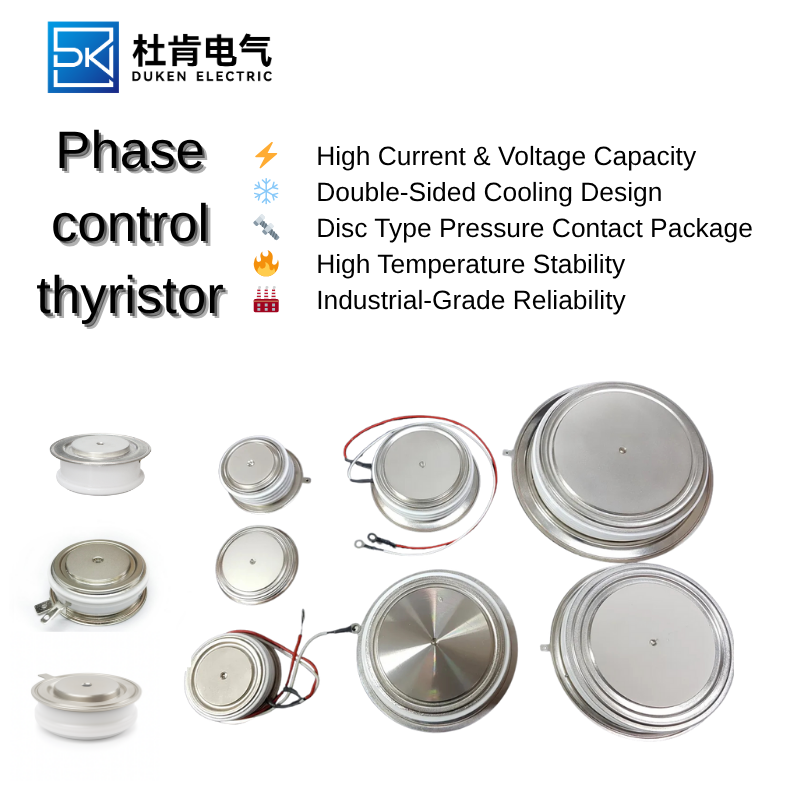
Common Installation Mistakes to Avoid with 4000A Phase Control Thyristors
High-power thyristor systems are often designed with strong theoretical safety margins, yet many field failures are caused by simple installation mistakes. At the 4000A level, minor errors in pressure, alignment, airflow, or wiring can create large consequences because the device operates under substantial electrical and thermal stress. Understanding the most common installation failures is therefore one of the best ways to improve reliability from the start.
Mistake 1: Treating installation as a purely mechanical task
One of the biggest errors is assuming that installation ends once the thyristor is bolted into position. In reality, the semiconductor, heat sink, busbars, gate drive, and protection network form one integrated operating system. A mechanically neat installation can still be electrically unstable or thermally unsafe.
This problem is frequently seen in mining equipment power control forced-cooling heat sink 4000A phase control thyristor applications, where teams may focus on rugged hardware but underestimate the interaction between contamination, heat rejection, and electrical switching conditions. Installation must be reviewed as a complete functional assembly, not as separate isolated tasks.
Mistake 2: Poor contact surface preparation
If the mating surfaces are scratched, oxidized, dirty, or uneven, thermal resistance rises. The device may still operate initially, but localized heating can accelerate wear and lead to early failure. Installers sometimes apply too much thermal compound in an attempt to compensate, which only adds another problem.
In systems using AC power regulators datasheet KP4000A-6500V 4000A phase control thyristor, ignoring the recommended surface quality and pressure assumptions means the assembly no longer reflects the conditions on which the expected thermal performance was based. Good installation starts with surface discipline.
Mistake 3: Incorrect clamping force
Pressure-mounted semiconductor devices depend on correct and even clamping. Too little force causes poor thermal transfer. Too much force can damage the package or create long-term mechanical stress. Another common mistake is applying force unevenly, which leads to inconsistent contact distribution.
This risk becomes especially serious in large-scale heating elements 6500 V VRRM 4000A phase control thyristor systems, where repeated heating cycles expand and contract the surrounding structure. If the initial clamping method is poor, the assembly can drift further out of tolerance with time.
Mistake 4: Ignoring airflow behavior
Many failed installations technically include cooling fans, but the airflow path is ineffective. Air may bypass the heat sink, recirculate inside the cabinet, or be restricted by dust, cable bundles, or poorly placed panels. The result is a system that seems properly cooled on paper but runs too hot in service.
For mining equipment power control forced-cooling heat sink 4000A phase control thyristor cabinets, this mistake is even more common because dusty environments gradually reduce cooling efficiency. Good design must anticipate contamination and provide maintainable filtration and inspection access.
Mistake 5: Stressing the device with bad busbar alignment
A 4000A thyristor should not be forced into position by misaligned conductors. Busbars that pull sideways on the terminals or clamp structure can distort the assembly and compromise both electrical and thermal performance. Poor conductor geometry also increases stray inductance, which can worsen switching transients.
This is a major issue in installations based on AC power regulators datasheet KP4000A-6500V 4000A phase control thyristor, because real transient stress is strongly influenced by physical layout. A correct rating does not protect against a poor current path.
Mistake 6: Weak gate wiring practice
Some installers treat gate wiring as secondary because it carries little power compared with the main current path. That is a mistake. A noisy or poorly routed gate circuit can cause misfiring, unstable control angle, or inconsistent conduction behavior. Long parallel routing near power conductors is particularly risky.
In large-scale heating elements 6500 V VRRM 4000A phase control thyristor applications, stable gate triggering is essential for accurate thermal process control. Small trigger irregularities can become process-quality problems long before they become obvious electrical faults.
Mistake 7: Incomplete commissioning
Another common failure point is rushing the startup process. Teams may energize the system once, see that it works, and release it for full operation without staged validation. This skips the opportunity to detect rising temperature, poor airflow distribution, loose joints, or unexpected trigger noise under partial load and full load conditions.
For mining equipment power control forced-cooling heat sink 4000A phase control thyristor installations, proper commissioning should include inspection under realistic vibration and contamination conditions. For AC power regulators datasheet KP4000A-6500V 4000A phase control thyristor assemblies, measurements should be compared with expected operating values rather than accepted at face value. And in large-scale heating elements 6500 V VRRM 4000A phase control thyristor control systems, multiple load points should be tested to confirm stable and repeatable behavior.
How to avoid these problems
The best prevention strategy is a disciplined installation checklist supported by clear torque values, surface preparation rules, cooling verification steps, and staged commissioning records. Training also matters. Technicians should understand why each step matters, not simply follow a sequence. When teams connect mechanical, thermal, and electrical thinking, installation quality improves dramatically.
Conclusion
Most installation failures with 4000A phase control thyristors are preventable. Poor surface preparation, wrong clamping force, ineffective airflow, stressed busbars, noisy gate wiring, and incomplete commissioning are recurring problems that can be avoided with better process control. In high-power systems, careful installation is not extra caution; it is standard engineering practice.