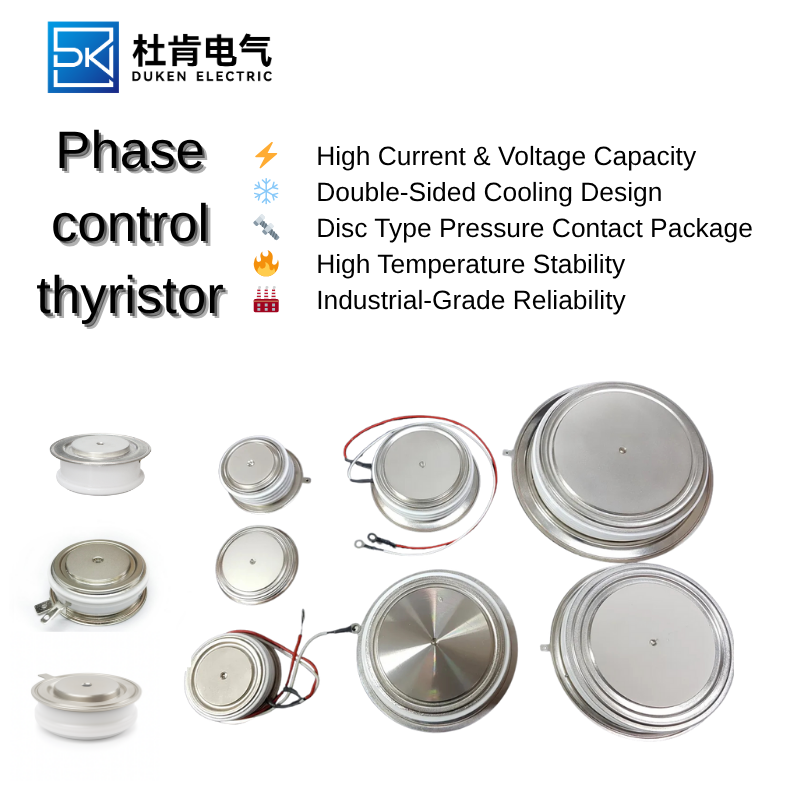
Commissioning and Maintenance Checklist for 4000A Phase Control Thyristor Assemblies
A successful installation is only the beginning of reliable operation. In high-power industrial systems, commissioning determines whether the design assumptions are correct, and maintenance determines whether that performance can be sustained over years of production. For 4000A phase control thyristor assemblies, the cost of incomplete verification is high because faults often appear under load, temperature rise, or repeated cycling rather than during static inspection.
The purpose of structured commissioning
Commissioning should not be treated as a quick energization step. It is a controlled validation process that confirms thermal, electrical, and mechanical behavior under realistic operating conditions. The most common mistake is assuming that if the system starts once, it is ready for full-duty service. In reality, stable performance must be demonstrated through staged load testing and careful measurement.
A system designed for mining equipment power control forced-cooling heat sink 4000A phase control thyristor duty requires especially disciplined commissioning because field conditions can magnify weaknesses in cooling, support structure, and electrical protection. Dust, vibration, and variable load profiles make it important to validate margins rather than merely prove basic functionality.
Pre-energization checklist
Mechanical integrity
Before power is applied, verify clamping force, support rigidity, busbar alignment, and fastener security. The thyristor body should show no signs of uneven pressure or mechanical distortion. Heat sink ducts, fan guards, and access panels should all be in their intended positions.
Control system readiness
The trigger system must be checked for signal amplitude, timing consistency, and channel isolation. Control interlocks, fault detection logic, fan alarms, and overtemperature monitoring should all be tested before the power stage is exposed to full voltage. This is particularly important in cabinets based on AC power regulators datasheet KP4000A-6500V 4000A phase control thyristor, where the full system performance depends on correct interaction between semiconductor hardware and control electronics.
Staged commissioning under load
Low-energy verification
Start with low-risk functional testing. Confirm that gate pulses arrive as intended, protective circuits are connected properly, and no abnormal heating occurs in auxiliary wiring. Measure insulation resistance and continuity where appropriate, and verify the response of emergency shutdown circuits.
Gradual load increase
Once low-energy checks are complete, increase load progressively while monitoring voltage drop, current stability, and heat sink temperature. Fan performance should be observed during each load step. In a large-scale heating elements 6500 V VRRM 4000A phase control thyristor installation, gradual loading is valuable because it reveals how the system behaves during power ramp-up, which often differs from steady-state behavior.
Key maintenance points after commissioning
Reliable maintenance begins by documenting the baseline condition recorded during commissioning. That includes temperatures, voltage drops, fan current, airflow condition, and visual observations. Later inspections become far more useful when they can be compared with known good values rather than judged in isolation.
For mining equipment power control forced-cooling heat sink 4000A phase control thyristor assemblies, maintenance intervals should reflect the contamination level of the site. Filter inspection, fan cleaning, and heat sink examination are not optional tasks. A partially blocked airflow path can raise semiconductor temperature long before a general cabinet alarm is triggered.
Routine inspection strategy
Thermal checks
Periodic thermal inspection is one of the most effective maintenance tools. Infrared scanning or direct sensor review can reveal loose joints, failing fans, or degraded thermal contact. When one assembly runs hotter than comparable units under similar load, further investigation is justified immediately.
Electrical checks
Over time, bolted joints may relax, insulation may degrade, and gate wiring may be exposed to additional noise. Installers should therefore review terminal torque, cable condition, protection devices, and trigger waveform quality at planned intervals. In systems defined around AC power regulators datasheet KP4000A-6500V 4000A phase control thyristor, maintenance should confirm that real operating conditions still align with the assumed duty cycle and thermal model.
Maintenance under process conditions
Many failures do not appear during idle inspection. They emerge when the process is hot, the load is fluctuating, and the cabinet has been running for several hours. Maintenance strategy should therefore include observation during normal production. In large-scale heating elements 6500 V VRRM 4000A phase control thyristor service, this means checking whether the control angle remains stable, whether current sharing stays balanced, and whether any insulation surfaces show signs of discoloration or stress.
A similar principle applies to mining equipment power control forced-cooling heat sink 4000A phase control thyristor systems, where vibration under actual machine operation may affect connectors differently than a static shutdown inspection. Documentation should note not only defects but also trends, because gradual deterioration often provides warning before failure.
End-of-life indicators and replacement planning
Semiconductor assemblies rarely fail without clues. Rising operating temperature, increasing voltage drop, fan degradation, repeated nuisance trips, and visible wear in pressure hardware all indicate the need for closer evaluation. Facilities that depend on continuous operation should keep critical spares available and define replacement criteria in advance.
This planning is wise for AC power regulators datasheet KP4000A-6500V 4000A phase control thyristor equipment because replacement decisions are easier and safer when based on trend data rather than emergency conditions. In demanding lines using large-scale heating elements 6500 V VRRM 4000A phase control thyristor control, preventive replacement can be more economical than risking unplanned shutdown during peak production.
Conclusion
Commissioning proves that the assembly works; maintenance proves that it will keep working. For 4000A phase control thyristor systems, the most effective approach combines staged validation, documented baseline values, disciplined thermal inspection, and realistic maintenance under operating conditions. Long-term reliability is the result of process, not luck.