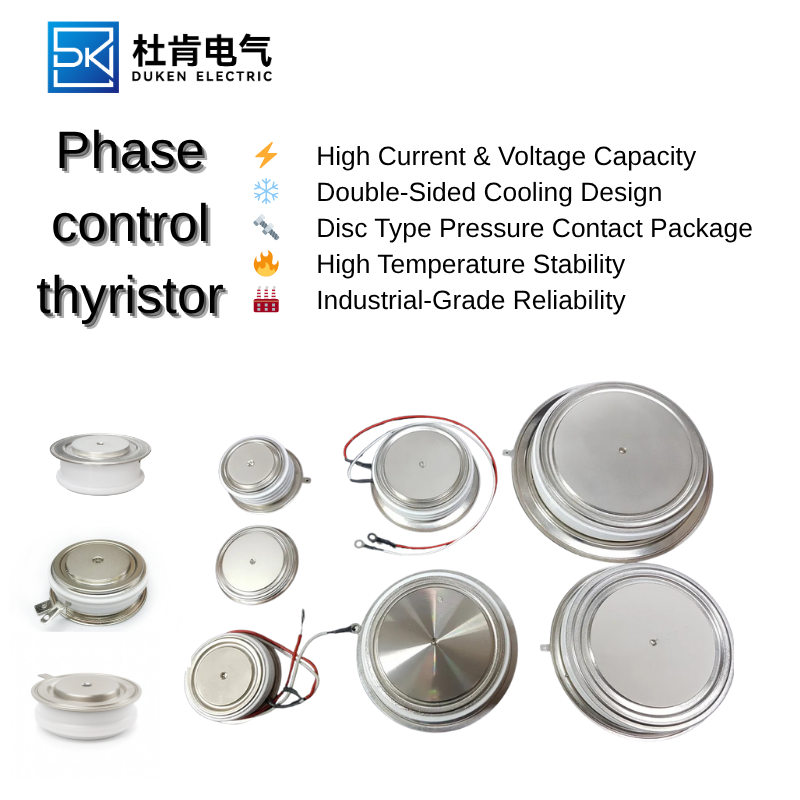
Choosing the Right 1200A Phase Control Thyristor Supplier for Flexible MOQ and Stable Quality
Selecting a supplier for a 1200A phase control thyristor is about far more than comparing quotations. In industrial power electronics, the supplier’s ability to support flexible MOQ, repeatable quality, and dependable communication often determines whether a project moves smoothly from validation to mass deployment. Buyers need more than a catalog rating. They need confidence that the product will perform consistently across production lots and real operating conditions.
The Relationship Between MOQ and Supplier Capability
Many buyers assume that a low MOQ automatically indicates flexibility and customer focus. Sometimes that is true, but not always. In some cases, low MOQ is simply a sales tactic without adequate engineering support behind it. A serious industrial supplier should be able to explain what is available for samples, what is available for pilot runs, and what changes when the buyer enters volume procurement.
This is especially important for applications such as a battery charging rectifier robust insulation for high voltage 1200A phase control thyristor. In battery charging systems, long operating cycles and electrical safety margins matter as much as current rating. Buyers should ask whether the supplier can provide detailed specifications for insulation capability, assembly consistency, and thermal design support. A low MOQ is useful only when the product delivered for testing truly reflects the quality of later production.
The same logic applies to a static VAR compensator (SVC) high dv/dt immunity 1200A phase control thyristor. SVC applications often involve fast electrical transitions and demanding grid conditions. In those circumstances, the supplier must do more than promise stock availability. The buyer should evaluate whether the supplier understands dv/dt performance, commutation behavior, and application-specific reliability expectations. Flexible MOQ is valuable, but technical credibility is what makes that flexibility useful.
What Stable Quality Really Means
Stable quality means consistency across multiple layers of manufacturing and support. It includes wafer selection, assembly control, testing, packaging, traceability, and communication. If the supplier cannot describe these processes clearly, buyers should be cautious. For a 1200A device, even minor inconsistency can create serious problems once the product is installed in a high-power cabinet or converter system.
A high current switching device extended temperature range (–40°C to +85 °C) 1200A phase control thyristor must be judged by more than its headline rating. The buyer should ask about thermal cycling performance, low-temperature startup behavior, and package durability under repeated load. If the application involves variable environments or outdoor exposure, stable quality becomes even more important than aggressive pricing.
For a battery charging rectifier robust insulation for high voltage 1200A phase control thyristor, stable quality also includes reliable insulation structure and predictable field performance. Buyers often underestimate how much installation confidence depends on documentation, marking clarity, and consistent production controls. A supplier who supports these details can reduce troubleshooting time later.
Questions Buyers Should Ask Before Committing
A practical supplier evaluation should include commercial, technical, and operational questions. Buyers should ask what MOQ applies to samples, qualification orders, and production orders. They should ask whether test reports can be supplied, whether date-code consistency can be managed, and whether custom packaging or labeling is available. Equally important, they should confirm lead times and what happens if demand increases suddenly.
For a static VAR compensator (SVC) high dv/dt immunity 1200A phase control thyristor, the conversation should include application experience. Has the supplier worked with reactive power compensation systems before? Can they explain how the device is tested for rapid transient conditions? Can they support matching or recommendation for related assemblies? These answers help separate trading activity from true product competence.
When the project requires a high current switching device extended temperature range (–40°C to +85 °C) 1200A phase control thyristor, buyers should also ask about storage guidelines, transportation considerations, and expected behavior across the full ambient range. A good supplier should not avoid these questions. Instead, they should be prepared to support them with practical data and application guidance.
Building a Reliable Supply Relationship
The strongest supplier relationship is built in stages. Buyers often begin with a trial order, confirm performance, then align on recurring volume. This process works well because it allows both sides to prove reliability before larger commitments are made. In this model, MOQ becomes a bridge between testing and scale. The supplier demonstrates responsiveness at low volume, and the buyer gains confidence for future purchasing.
That matters for a battery charging rectifier robust insulation for high voltage 1200A phase control thyristor, where approval decisions may involve both engineering and procurement teams. It matters equally for a static VAR compensator (SVC) high dv/dt immunity 1200A phase control thyristor, where technical review may be more demanding than usual. And for a high current switching device extended temperature range (–40°C to +85 °C) 1200A phase control thyristor, long-term confidence often depends on repeatability under harsh environmental conditions.
A supplier who can support flexible MOQ, transparent communication, and consistent production is far more valuable than one who only offers a lower number on paper. For industrial buyers, the right partner is the one who helps reduce uncertainty across the whole lifecycle of the project.