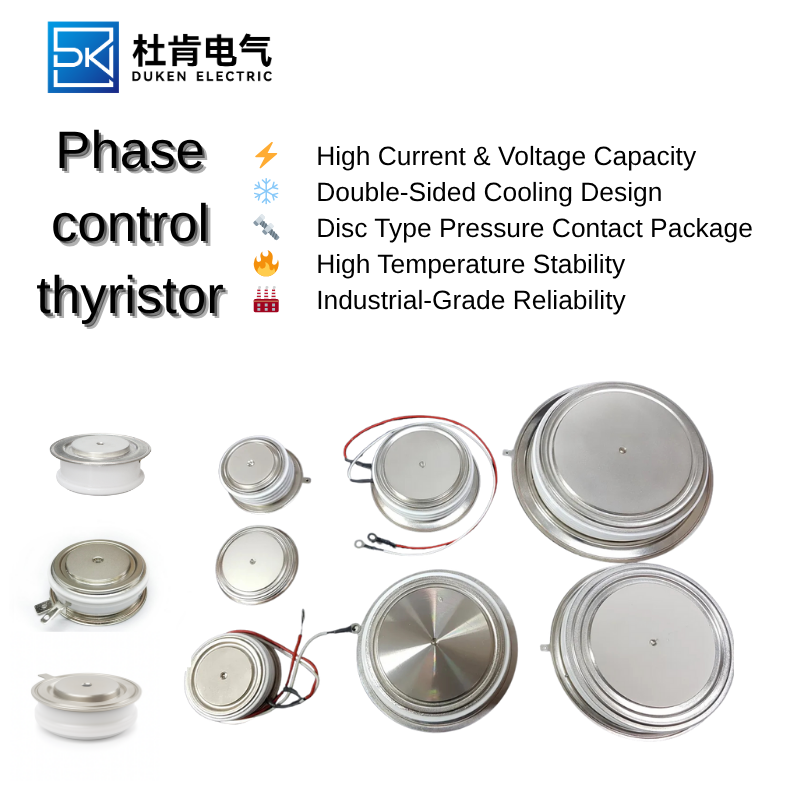
Best Practices for Mounting and Cooling a 4000A Phase Control Thyristor
In high-power semiconductor assemblies, mounting quality and thermal management often determine whether a system operates for years or fails unexpectedly after a short period. A 4000A phase control thyristor handles substantial electrical stress, but the real challenge comes from the interaction between current, heat, pressure, and airflow. Even when the device rating is correct, poor cooling design or inconsistent clamping can reduce performance and accelerate aging.
Why mounting and cooling matter so much
The thyristor junction converts part of the conducted electrical energy into heat. At 4000A, that heat load becomes significant, and the safety margin depends heavily on how efficiently it is transferred from the semiconductor junction to the surrounding environment. This transfer path includes the internal package, the contact surfaces, the heat sink, and the moving air or liquid that removes the heat.
For mining equipment power control forced-cooling heat sink 4000A phase control thyristor systems, the thermal challenge is intensified by contaminated air, vibration, and fluctuating duty cycles. The cooling solution must therefore do more than meet a nominal temperature calculation. It must remain effective under field conditions where filters clog, fans age, and environmental dust accumulates over time.
Surface preparation and contact quality
Flatness and cleanliness
Every successful installation begins with the mating surfaces. Pressure-mounted thyristors require smooth, flat contact faces so the clamping force spreads evenly across the device. Oxide layers, scratches, or embedded debris can create local thermal resistance, which increases temperature in a small region of the semiconductor and leads to long-term damage.
A system built around AC power regulators datasheet KP4000A-6500V 4000A phase control thyristor should always be mounted according to the specified flatness and force requirements because the published thermal values assume correct surface condition. If the contact quality is poor, the real thermal resistance will be worse than the datasheet model.
Thermal compound use
Thermal compound improves contact by filling microscopic air gaps. However, too much compound becomes counterproductive. The recommended method is a thin, uniform layer applied only where needed. Engineers should avoid uneven buildup, because it can shift pressure distribution and contaminate nearby insulation surfaces.
Clamping force control
A 4000A device cannot be treated like a small low-power component. Clamping force must be applied gradually and in the correct order. When the force is too low, contact resistance increases; when it is too high, the package may crack or become mechanically stressed. The assembly hardware should also be checked for long-term stability so that repeated thermal cycling does not loosen the structure.
This issue is particularly relevant for large-scale heating elements 6500 V VRRM 4000A phase control thyristor installations, where long heat cycles can repeatedly expand and contract the surrounding busbars and support frames. Good mechanical design should allow thermal movement without distorting the semiconductor assembly.
Designing the airflow path
Air quantity is not enough
Many engineers focus only on fan capacity, but total airflow volume is only one part of the answer. The air must reach the heat sink surfaces evenly and with minimal recirculation. Dead zones, bypass gaps, or blocked channels can raise local temperatures while overall cabinet airflow still appears acceptable.
A cabinet for mining equipment power control forced-cooling heat sink 4000A phase control thyristor service should use directed airflow, reliable filtration, and easy maintenance access. The fan arrangement should support stable cooling not only when the cabinet is clean, but also when moderate dust buildup is present between maintenance cycles.
Heat sink structure and orientation
The heat sink should be selected for both thermal capacity and pressure compatibility. Fin spacing, channel depth, and orientation relative to the airflow all affect performance. In some systems, a well-designed duct can improve cooling more effectively than increasing fan size. Heat sinks should also be mounted so that service staff can inspect them without dismantling half the cabinet.
For assemblies based on AC power regulators datasheet KP4000A-6500V 4000A phase control thyristor, the heat sink selection should reflect actual duty cycle, ambient temperature, and overload behavior rather than theoretical nominal current alone. Conservative thermal design usually reduces maintenance cost more effectively than chasing the smallest possible hardware footprint.
Integration with electrical layout
Cooling performance is influenced by electrical design as well. Busbars that obstruct airflow or transfer additional heat into the assembly can undermine an otherwise good thermal solution. Similarly, if gate wiring is routed through hot zones, control performance may become less stable over time. Mechanical and electrical teams should therefore review the cabinet layout together.
This systems approach is essential in large-scale heating elements 6500 V VRRM 4000A phase control thyristor applications, where both the supply current and the thermal inertia of the load can keep the cabinet under stress for extended periods. The cooling arrangement must support steady-state operation, start-up peaks, and repetitive control transitions.
Inspection and long-term maintenance
Even the best initial installation needs periodic verification. Engineers should inspect fan operation, filter condition, pressure hardware, and thermal interface integrity. Infrared temperature checks are useful during maintenance because they can reveal blocked airflow or degraded contact before a failure occurs. Any unexpected increase in voltage drop or heat sink temperature should be investigated early.
Aging fans, loose fasteners, and contaminated fins are common causes of thermal decline in mining equipment power control forced-cooling heat sink 4000A phase control thyristor systems. Likewise, periodic review of AC power regulators datasheet KP4000A-6500V 4000A phase control thyristor installation assumptions can confirm that the original design still matches the present operating profile. In large production lines using large-scale heating elements 6500 V VRRM 4000A phase control thyristor assemblies, preventive thermal maintenance is far less costly than unscheduled downtime.
Conclusion
Mounting and cooling are not secondary details in a 4000A phase control thyristor system; they are central to reliability. A clean contact interface, controlled clamping force, effective airflow path, and disciplined maintenance routine together create the conditions for stable, long-life performance. In high-power environments, thermal discipline is operational discipline.