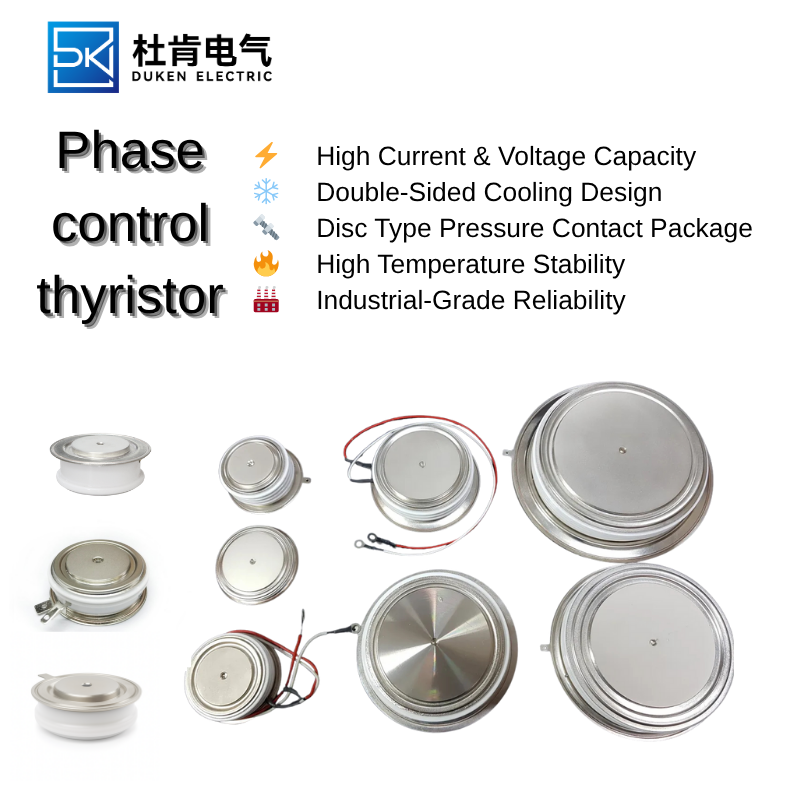
Advanced Thermal Testing of 2200A Thyristors for Battery Charging
Introduction
As energy infrastructure scales up to meet growing industrial and renewable power demands, so does the need for high-performance semiconductor components. The 2200A phase control thyristor, when utilized in high-load battery charging rectifiers, must maintain consistent functionality under intense thermal conditions. This has made high thermal stability for industrial battery chargers 2200A phase control thyristor a crucial specification.
This article explores advanced testing methodologies for verifying thermal stability in these high-power thyristors and how such procedures ensure long-term performance in mission-critical applications.
1. Why Thermal Stability Is Critical in Industrial Chargers
Battery chargers in industrial systems—such as those supporting EV charging stations, backup power, or grid-scale storage—are subjected to long duty cycles, rapid current changes, and variable environmental conditions. The 2200A phase control thyristor in these applications must:
Handle prolonged high-current conduction
Withstand heat buildup without derating
Deliver consistent voltage control during thermal transients
Testing for high thermal stability for industrial battery chargers 2200A phase control thyristor ensures these needs are met with reliability and resilience.
2. Thermal Stress Simulation Techniques
Modern testing environments subject thyristors to conditions beyond regular datasheet parameters to evaluate failure thresholds and safe margins.
a. Continuous High-Load Testing
The thyristor is operated at near-maximum rated current for extended hours. Thermocouples measure case and junction temperatures in real-time. The goal is to observe if the high thermal stability for industrial battery chargers 2200A phase control thyristor remains intact under full thermal load.
b. Power Cycling Endurance
Repetitive heating and cooling cycles simulate real-world usage, such as on/off switching in battery charging intervals. This reveals potential degradation in internal solder joints, bond wires, or silicon integrity.
c. Environmental Chamber Testing
Thyristors are placed in chambers with controlled humidity and temperature shifts. This determines whether external packaging and internal die can resist condensation, corrosion, and temperature-induced mechanical strain.
These combined tests mimic the actual life conditions the device would experience in an industrial battery charger, confirming that the high thermal stability for industrial battery chargers 2200A phase control thyristor can handle them.
3. Evaluation Metrics and Pass/Fail Criteria
Evaluators assess the following to determine a pass:
Stable on-state voltage drop across temperature range
Leakage current remaining within safe limits
Consistent gate triggering behavior under heat
No structural damage after thermal cycles
For a 2200A phase control thyristor, minor deviations are acceptable, but thermal instability or breakdowns in performance are considered failures.
4. Real-World Application: Benefits of Thermal Certification
When tested for high thermal stability for industrial battery chargers 2200A phase control thyristor, devices:
Require less overdesign margin in cooling systems
Improve total charger efficiency due to lower thermal resistance
Maintain gate control precision, even during ambient surges
Reduce risk of thermal runaway and fire hazards
End-users in telecom, manufacturing, and power storage facilities benefit from this reliability with lower downtime and maintenance costs.
Conclusion
Thermal testing is a non-negotiable step in validating the performance of the high thermal stability for industrial battery chargers 2200A phase control thyristor. By simulating operational extremes and evaluating long-term behavior, manufacturers can ensure that these high-current devices will remain stable, safe, and efficient throughout their lifecycle. In an industry where every ampere matters, thermal reliability ensures sustainable power delivery.