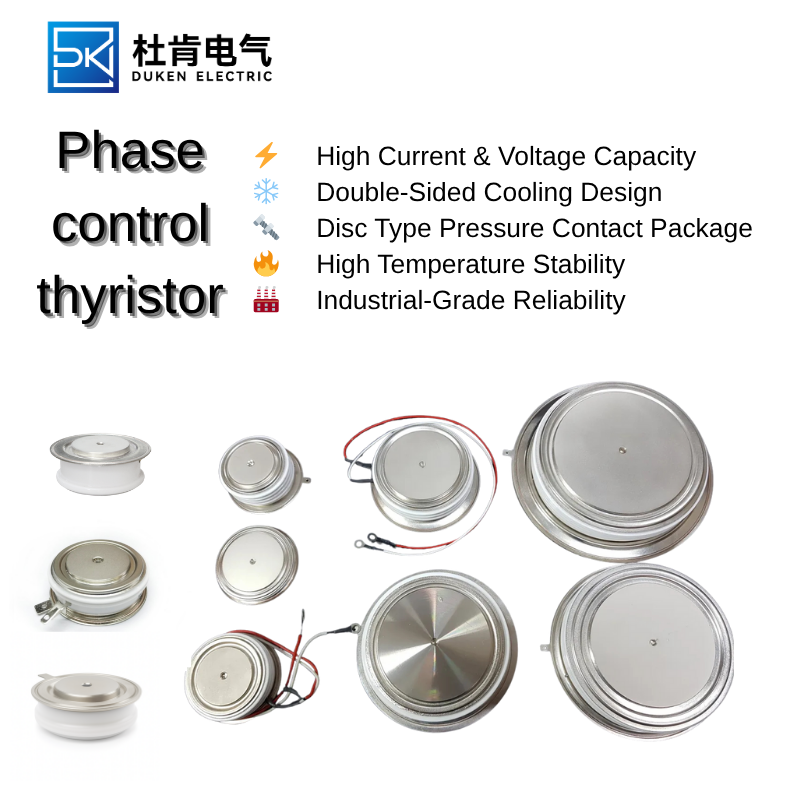
A Practical Engineering Guide to 600A Phase Control Thyristor Performance
Engineers responsible for power control equipment often face a familiar challenge: how to choose a thyristor that performs reliably not only under rated conditions, but also during startup, overload, thermal drift, and long-term service. A 600A phase control thyristor may look suitable when judged by its nameplate rating alone, yet true application success depends on how well the device handles real switching conditions. Performance is shaped by gate response, surge tolerance, insulation design, thermal behavior, and operating temperature range.
Performance starts with controlled switching
In phase control circuits, the thyristor must respond to a gate pulse at the right moment and conduct predictably through the required portion of the AC cycle. When gate performance is inconsistent, the whole system can suffer from unstable output, unbalanced conduction, increased harmonic distortion, or avoidable heating. That is why gate trigger control high surge current rating 600A phase control thyristor is an important engineering focus. Good trigger control is directly tied to safe and repeatable phase-angle operation, especially in high-power rectifiers and regulators.
Surge tolerance matters because many industrial loads do not behave gently. Transformers, motors, resistive heaters, and mixed industrial loads can all create short but severe current peaks. A gate trigger control high surge current rating 600A phase control thyristor gives the system a stronger chance of surviving these events without junction damage. This is especially important where the protection system needs brief time to operate or where repeated overload conditions are part of normal duty.
In parallel, engineers should not ignore the structural side of performance. A robust insulation for high voltage high thermal stability 600A phase control thyristor supports safer operation in demanding electrical environments while helping preserve stability under extended heat exposure. Good insulation and thermal strength often translate into more predictable behavior across the working life of the equipment.
Thermal behavior and real-world endurance
Thermal performance is often the dividing line between short-term success and long-term reliability. A thyristor that passes a bench test may still struggle in an enclosed cabinet with restricted airflow, elevated ambient temperature, or frequent load cycling. Engineers need to consider junction temperature rise, conduction loss at different firing angles, heat sink efficiency, and the quality of the mechanical interface between device and cooling surface.
This is where robust insulation for high voltage high thermal stability 600A phase control thyristor becomes highly relevant. Thermal stability reduces parameter drift and supports consistent operation during prolonged high-load periods. In high-voltage designs, robust insulation also helps maintain safety margins when electrical stress and heat combine in the same assembly.
Environmental exposure adds another layer of complexity. A gate trigger control extended temperature range (–40°C to +85 °C) 600A phase control thyristor is often a better choice for power systems used in transport, renewable infrastructure, or outdoor industrial control. Cold start conditions can affect gate response, while hot ambient conditions can narrow thermal margins. Selecting a device with proven extended-range performance gives the designer a broader and more realistic operating envelope.
Selecting with system interactions in mind
No thyristor operates in isolation. Gate driver strength, snubber network design, protection coordination, busbar inductance, and cooling arrangement all shape actual performance. Engineers should therefore evaluate the semiconductor together with the surrounding circuit. A device with excellent datasheet numbers can still behave poorly if the gate pulse is weak or if transient suppression is inadequate.
In systems that face repeated transients, gate trigger control high surge current rating 600A phase control thyristor remains a smart selection target because it aligns with the realities of industrial power events. In systems with high electrical stress, robust insulation for high voltage high thermal stability 600A phase control thyristor helps maintain dependable operation even as temperature and voltage stresses overlap. Where environmental variation is significant, gate trigger control extended temperature range (–40°C to +85 °C) 600A phase control thyristor provides additional design confidence during commissioning and field service.
Turning specifications into better decisions
The best engineering decisions come from combining datasheet review with application logic. Instead of asking only whether the device can carry 600A, ask whether it can trigger cleanly, survive worst-case surge events, dissipate heat efficiently, and remain stable across the real temperature range of the installation. Review surge current ratings, gate characteristics, thermal resistance, insulation structure, and packaging style together rather than in isolation.
A practical selection approach gives priority to operating resilience. For many applications, gate trigger control high surge current rating 600A phase control thyristor will be essential because fault and startup conditions are unavoidable realities. For high-voltage and thermally demanding installations, robust insulation for high voltage high thermal stability 600A phase control thyristor offers meaningful value. And for wide-environment operation, gate trigger control extended temperature range (–40°C to +85 °C) 600A phase control thyristor helps ensure that the device performs not only in theory, but in the full range of actual service conditions.